Insights for Real Life
This article is for educational purposes and is not a substitute for therapy.
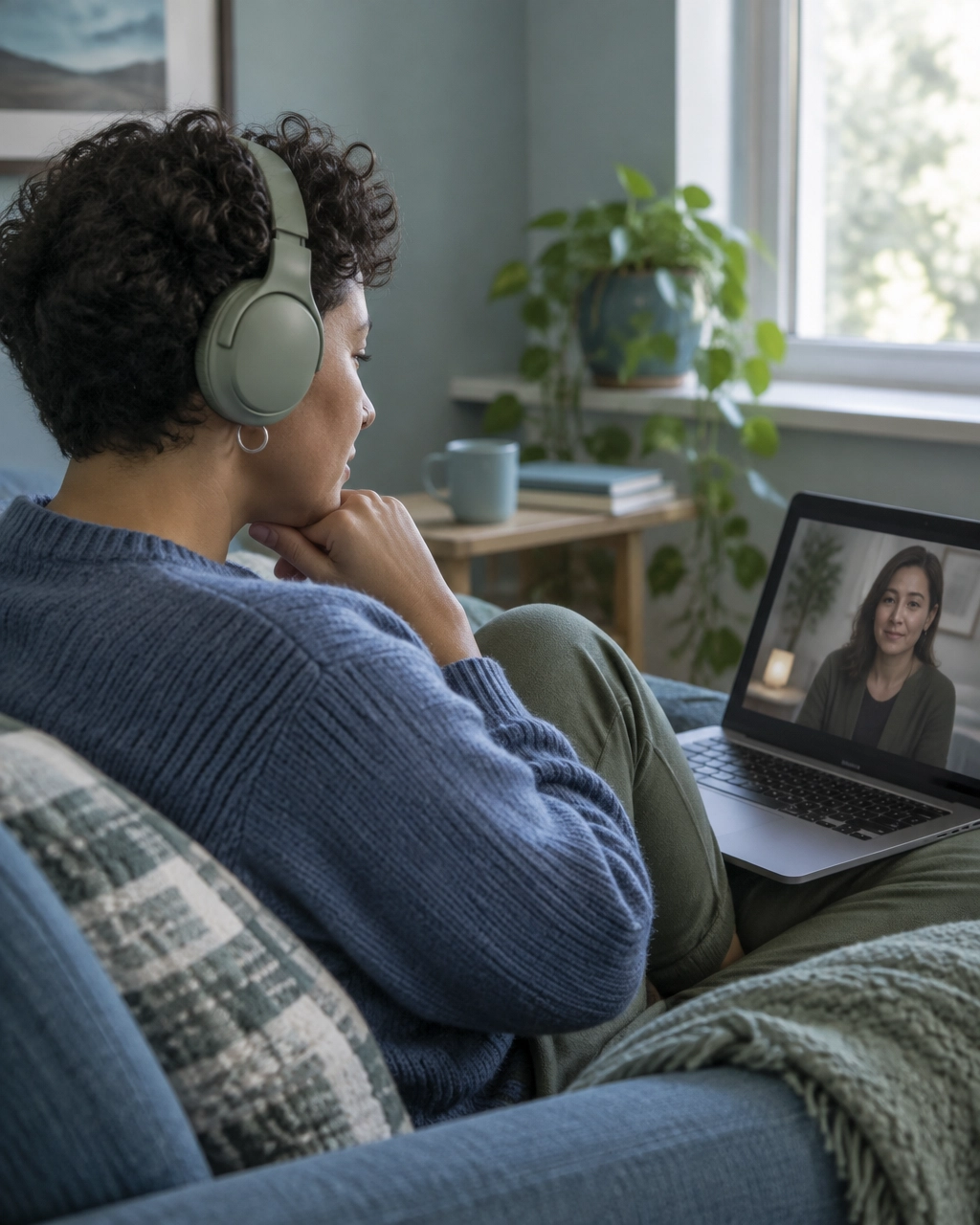
You can receive meaningful, effective therapy without driving to an office. Current research shows that video-based therapy often produces outcomes comparable to in-person care for concerns such as anxiety, depression, stress, and trauma-related symptoms. The best option for you depends on your needs, preferences, privacy, schedule, and connection with your therapist.
If you are considering telehealth therapy, you may wonder whether something important gets lost through a screen.
Can your therapist understand you? Can you build trust? Can virtual therapy help with anxiety, burnout, depression, perfectionism, or imposter syndrome?
The 2026 evidence offers reassurance. A systematic review and meta-analysis published in the Journal of Medical Internet Research examined randomized controlled trials comparing synchronous video-based psychotherapy with face-to-face therapy. Across 12 studies, 900 adults, and 41 outcome estimates, researchers found no significant difference in symptom reduction between video-based and in-person therapy.Read the 2026 review
That does not mean telehealth and in-person therapy feel identical for every person. It means the setting itself does not appear to determine whether therapy helps. The quality of the therapeutic relationship, the treatment approach, your goals, and your ability to engage all matter.
You are not choosing between “real therapy” and a lesser version. You are choosing the format that helps you participate consistently and openly.
The 2026 review focused specifically on live video therapy. It excluded telephone-only care, self-guided apps, asynchronous messaging, and group therapy. This made the comparison more direct: the same kind of professional psychotherapy delivered through video or in person.
The researchers found:
The authors also identified important limitations. The research base remains relatively small. Many studies focused on cognitive behavioral therapy and Western populations. The certainty of evidence was rated low because of risk of bias, study differences, and imprecise estimates.
That nuance matters. The research does not say that telehealth is automatically the right choice for everyone. It says that video therapy is a credible, evidence-supported option for many adults.
Therapy works through more than physical proximity. It works through safety, trust, collaboration, reflection, and practice.
A 2022 systematic review of 12 randomized controlled trials found no significant differences between telehealth and in-person psychotherapy in:
Review the findings from JMIR Mental Health
Earlier research also supports this pattern. A meta-analysis of 51 randomized controlled trials found little to no difference between therapist-guided remote cognitive behavioral therapy and in-person cognitive behavioral therapy across mental and somatic health concerns.Read the CMAJ meta-analysis
In simple terms, your therapy does not become less valuable because you are sitting at home.
You may already be carrying a full schedule. Work demands, school, caregiving, relationships, and daily responsibilities can make it difficult to add travel time to your week.
Telehealth can remove some of the practical barriers that keep you from starting or continuing therapy.
You may benefit from:
For example, you may be managing anxiety while working in a demanding role. You may be functioning well on the outside while feeling mentally exhausted, tense, or unable to stop overthinking. A virtual session may make it easier to receive support without losing additional time to traffic or office logistics.
Consistency matters. The most effective format is often the one you can attend regularly and use honestly.
Finding an affirming therapist matters. You deserve care that respects your identity without asking you to educate, defend, or minimize yourself.
Telehealth may offer additional comfort if you are looking for LGBTQ+ affirming support but do not feel comfortable seeking therapy close to home or work. You can choose a private setting where you feel more at ease discussing identity, family, relationships, workplace stress, coming out, self-acceptance, or minority stress.
At Horizon West Counseling’s LGBTQ+ affirming therapy service, therapy is collaborative, respectful, and grounded in evidence-based care. You can explore your experiences while building self-trust, emotional regulation, and stronger relationships.
Your environment matters. So does the therapist’s ability to understand and affirm you.
Telehealth is effective for many people, but it is not the best fit in every situation.
You may prefer in-person therapy if:
You may also discover that your preference changes over time. You might begin with telehealth because it feels accessible, then later decide that in-person sessions would better support your next stage of work.
There is no prize for choosing one format permanently. Your care can adapt as your needs change.
Your setting can support deeper work. Before your session, consider creating a space that feels private, comfortable, and emotionally safe.
Try these steps:
You do not need a perfect home office. You need enough privacy to be present.

Research often refers to the therapeutic alliance. This means the working relationship between you and your therapist.
A strong therapeutic relationship includes:
You may worry that a screen will make it harder to feel connected. That concern is understandable. Many people find, however, that they can build a meaningful relationship through video when the therapist is attentive, responsive, and genuinely engaged.
If you feel disconnected, say so. If you need more structure, ask for it. If you are unsure whether therapy is helping, bring that uncertainty into the room.
Together, you and your therapist can adjust the process.
Horizon West Counseling offers secure virtual therapy sessions for adults in Florida. Sessions are designed to fit real life while providing a confidential space to understand what you are experiencing and develop practical strategies for moving forward.
Virtual therapy may support you as you work through:
Learn more about Horizon West Counseling’s therapy services or review the telehealth questions in our FAQ.

Ask yourself:
You do not need to know the answer before reaching out. A consultation can help you discuss your concerns, ask questions, and explore whether the therapist and format feel like a good fit.
Telehealth therapy is not a shortcut. It is a flexible way to access meaningful support. For many adults, it offers the privacy, consistency, and accessibility needed to begin making lasting changes.
If you are ready to explore therapy in a format that fits your life, schedule a free consultation with Horizon West Counseling. Together, you can decide whether Florida telehealth sessions support the care you are looking for.
The content on this website is for informational and educational purposes only and is not intended as medical or mental health advice. Reading this content does not establish a therapeutic relationship with Horizon West Counseling or its clinicians.If you are experiencing a mental health emergency, please call 911 or go to your nearest emergency room. If you are seeking support, we encourage you to contact a licensed mental health professional.
Horizon West Counseling


